TÜBİTAK ULAKBİM and WILEY Free Open Access Publishing Agreement – Webinar

Free Open Access Article Publishing Agreement, carried out through the collaboration between TÜBİTAK ULAKBİM and Wiley, will be reactivated as of 17 February, and within this framework, a webinar will be organized to inform our researchers about open access publishing processes, supporting them in reaching wider audiences, increasing their citation potential, and benefiting from open[…]

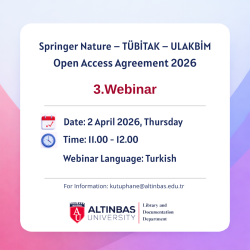
Springer Nature – TÜBİTAK – ULAKBİM Open Access Agreement: Webinar 1

Within the scope of the Transformative Agreement (TA) signed between Springer Nature and TÜBİTAK – ULAKBİM, which entered its third term as of January 1, 2026, the first webinar of 2026 will be held. This webinar will provide detailed information about the agreement’s scope, the participating institutions, open access publishing processes, and the opportunities offered to authors. Additionally, practical tips and recommendations[…]

Webinar :

A webinar titled “Scopus Training for Institutional Publication Analysis” will be organized by Elsevier. Detailed information regarding the webinar is provided below. Date: January 30, 2026 | Friday Time: 11:00 Registration Link: https://elsevier.zoom.us/webinar/register/WN_F1cFa88ET0yqLu-UtMJurg Scope: Within the scope of your Scopus institutional profile based on Scopus-indexed publications: Annual publication and citation trends Open Access publication rates[…]

Webinar: Scopus Training for Researchers

To support the effective use of research processes, a webinar will be organized by Elsevier. The training will be held online on Tuesday, January 27, 2026, at 15:00, and registration and further details are provided below. Date: January 27, 2026 | Tuesday Time: 15:00 Registration Link: https://elsevier.zoom.us/webinar/register/WN_3UWKy8rJTtCMYGjhI2q4Yw Scope: The webinar will address topics that support[…]

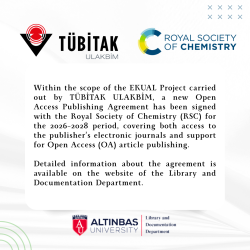
Royal Society of Chemistry (RSC) Database Access

Royal Society of Chemistry (RSC) database has been made available to our University through TÜBİTAK-ULAKBİM until 2028. Royal Society of Chemistry (RSC) is an organization engaged in academic publishing in chemistry and related disciplines. The RSC database provides access to peer-reviewed journals, academic books, and reference resources published in fields such as analytical chemistry, organic[…]

Institute of Physics (IOP) Database Access

Institute of Physics (IOP) database has been made available to our University through TÜBİTAK-ULAKBİM until 2028. Institute of Physics (IOP) Publishing is one of the world’s leading academic publishers in physics and related disciplines. The IOP database provides access to peer-reviewed journals, conference proceedings, and academic books published in fields such as physics, applied physics,[…]

Turcademy Database Access

Turcademy database has been made available to our University through TÜBİTAK-ULAKBİM. Turcademy is a multidisciplinary e-book platform consisting of eight distinct collections: Law, Health Sciences, Engineering Sciences, Natural Sciences, Fine Arts, Social and Human Sciences, Cultural Publications, and University Publications. Providing full-text access to more than 15,000 Turkish academic e-books published by leading academic publishers[…]

Announcement Regarding the TÜBİTAK–Springer Nature Open Access Quota

The open access agreement signed between TÜBİTAK ULAKBİM and Springer Nature, covering the years 2024–2026, became active as of January 1, 2026. The publication quota for 2026 has been set at 3,094 articles, and APC (Article Processing Charge) support will continue to be provided until the quota is fully used. The list of journals included[…]

Airisto AI Trial Access

Airisto AI tool trial access is available to our University until 01.12.2025. Airisto is an AI content-detection tool developed entirely with domestic resources. It analyzes Turkish and English academic texts (theses, articles, seminar papers, conference papers, etc.) using multi-layered methods and reports “possible” AI-generated content with transparent and easy-to-understand outputs. Each academic staff member is provided[…]